
Portugal at 40: Public perceptions of European enlargement in retrospect


Marking four decades since Portugal’s accession to the European Communities, the report «Portugal at 40», by Catherine E. De Vries, Professor of Political Science at IE University, examines how European citizens perceive the historical, political and economic impact of EU accession.
Drawing on data from the eupinions project, discover how European public opinion evaluates the success of Portugal’s accession, what impact Europe has had on Portugal’s democratic consolidation and economic transformation, and how generational dynamics shape the debate on future EU enlargement.
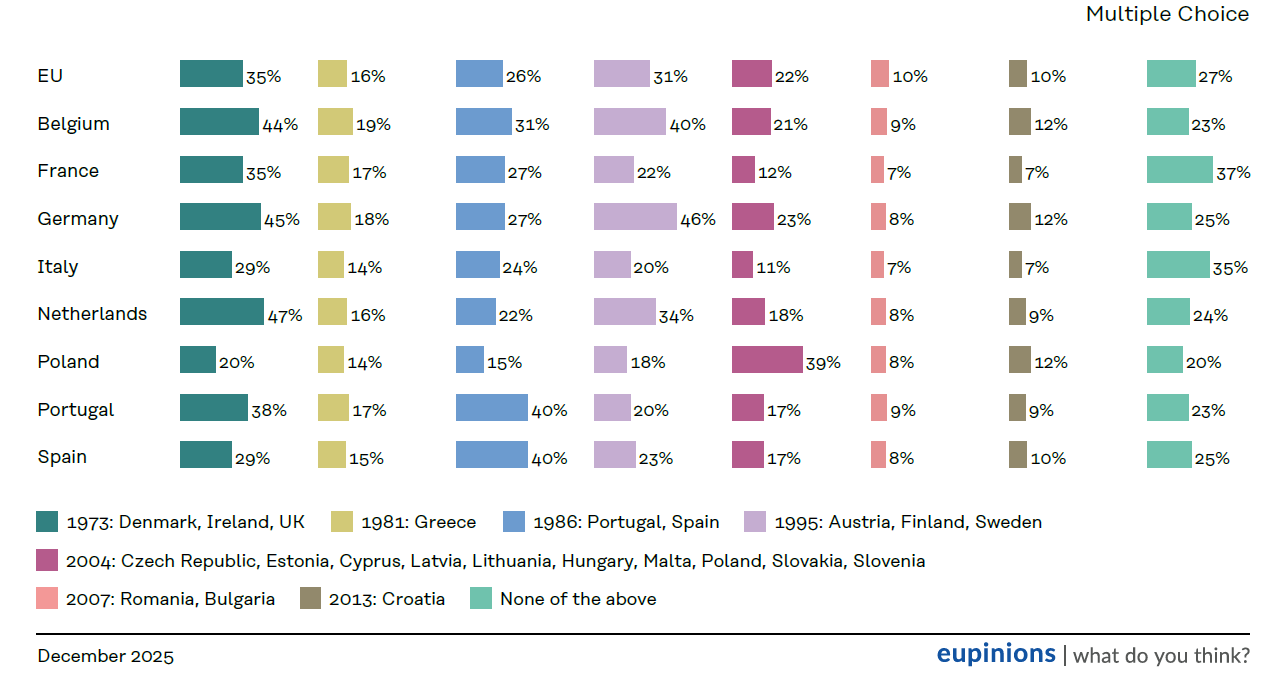
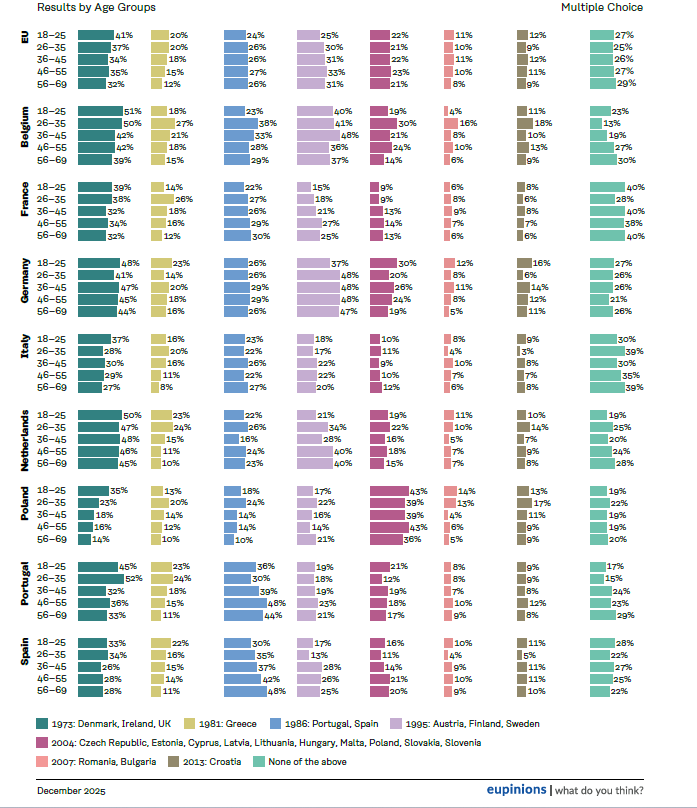
Regarding the 1986 accession of Portugal and Spain, the most favourable evaluations are found in the Iberian countries themselves — Portugal (40%) and Spain (40%) — followed by Belgium (31%). By contrast, support is lowest in Poland (15%), the Netherlands (22%) and Italy (24%). France displays widespread scepticism: 37% of respondents believe that none of the enlargements had a positive impact on the European Union (EU).
Overall, the 1973 and 1995 enlargements are the most positively perceived across Europe, while those of 2007 and 2013 receive the most limited support.
European citizens’ views are broadly favourable: across the EU, 70% of respondents believe that Portugal’s membership has had a positive impact on the EU, compared to 30% who hold a negative view.
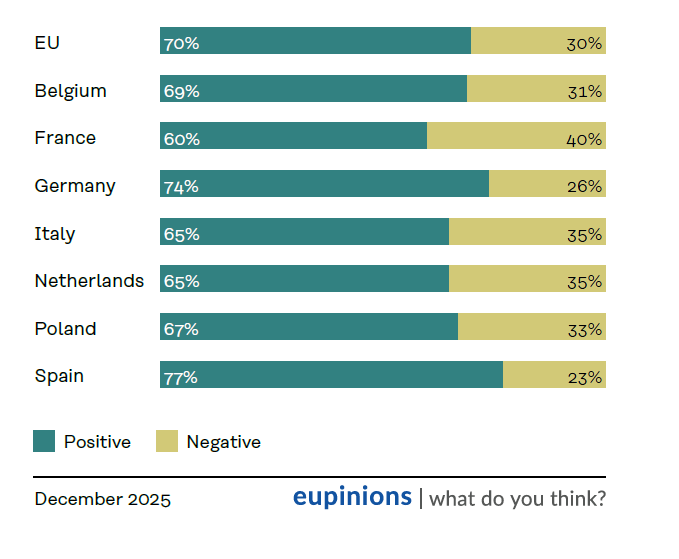
Support is particularly strong in neighbouring countries and key partners, notably Spain (77%) and Germany (74%). By contrast, support is weakest in France — the lowest figure in the sample, with 60% positive and 40% negative evaluations — followed closely by Italy and the Netherlands (both 65%).
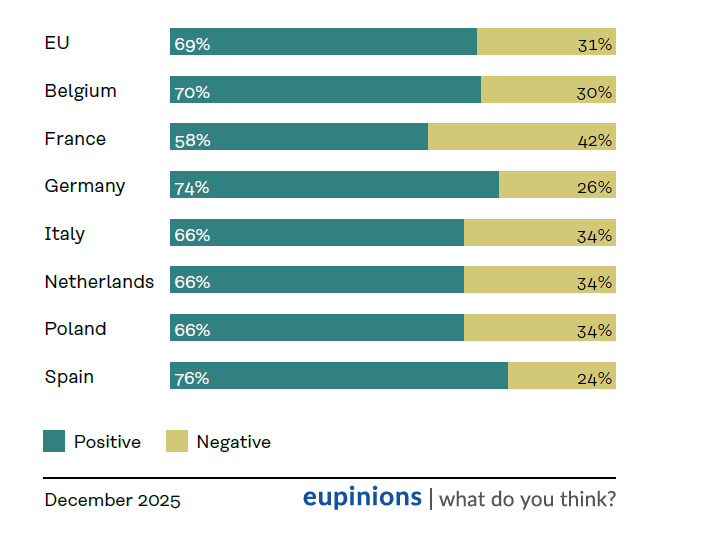
Across the EU, citizens view their own country’s contribution to the European project in largely positive terms: on average, 70% of respondents believe that their country’s accession has strengthened the European project.
Portugal stands out among the countries that view their own accession most positively (76%), surpassed only by Germany (80%). By contrast, France (58%) and Italy (60%) display comparatively more sceptical, but still net positive, assessments of the importance of their own country’s accession.
The Portuguese are the most positive about the impact of European integration on their democracy: 78% believe it has had a positive effect, compared to 22% who hold a negative view. These results are well above the EU average (61% positive, compared to 39% negative) and stand in particular contrast to France, the only country in the sample where a majority of respondents perceive a negative impact on democracy.
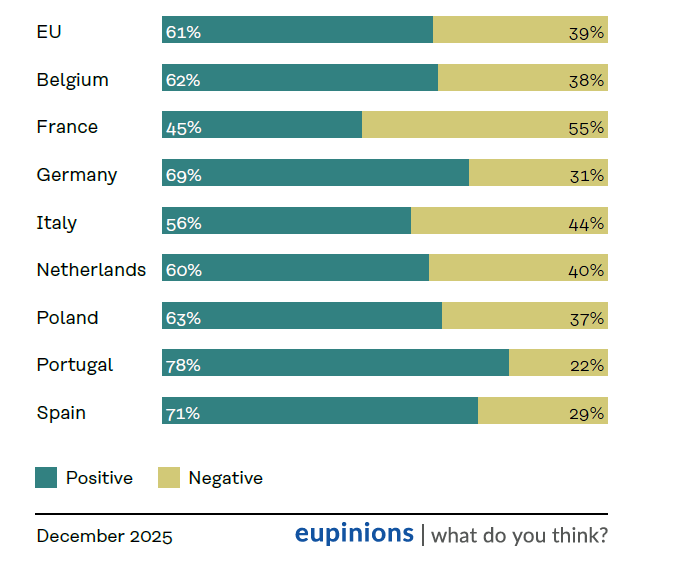
Portugal leads Europe in positive economic evaluations, indicating widespread recognition of the economic benefits of integration: 78% of respondents report a positive economic impact. Germany (72%), Poland (68%) and Spain (68%) follow.
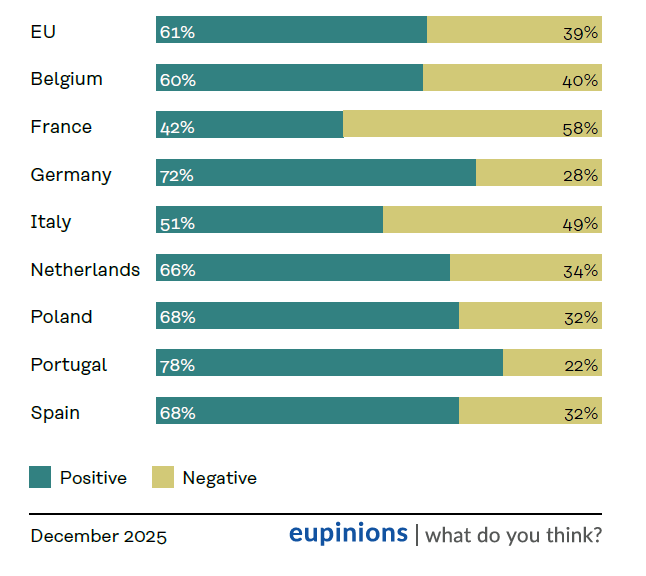
Overall, the economic impact of forty years of European integration is viewed in largely positive terms across the EU: on average, 61% of respondents believe that accession has had a positive impact on their country’s economy. At the other end of the scale, France is the only country where a clear majority hold a negative view: just 42% of respondents report a positive economic impact, compared to 58% who perceive a negative one.
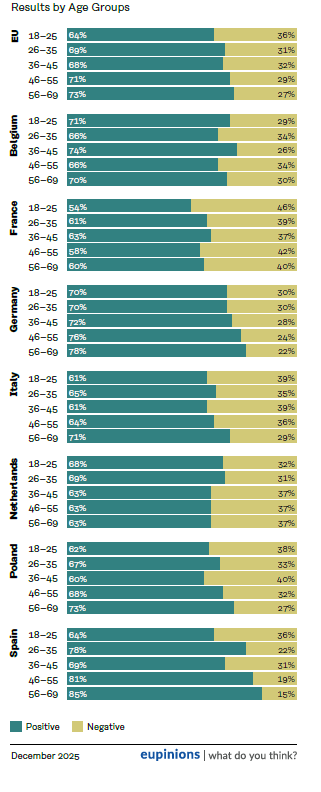
Respondents aged 56–69 view Portugal’s accession most favourably (73% at the EU level), with support peaking at 85% in Spain and 78% in Germany. Younger respondents aged 18–25 (64% across the EU), by contrast, are somewhat less enthusiastic, with France recording the lowest figure for this age group (54%).
The younger generation (aged 18–25) is more optimistic about EU enlargement (for example, 41% of these respondents view the 1973 enlargement positively), while older cohorts tend to be more cautious. Indeed, those aged 56–69 are the most likely to reject enlargement altogether: 29% believe that none of the enlargements had a positive impact on the EU.
Forty years after Portugal’s accession to the European Communities, this barometer provides a clear answer to a central question: How do European citizens evaluate past enlargements, in particular the case of Portugal? The findings point to a broadly positive assessment, but also reveal important variations that are relevant for current debates about the future of European integration.
As the European Union considers further expansion to countries such as Ukraine, Moldova and the Western Balkans, public opinion is crucial in determining the political feasibility of the project. The case of Portugal demonstrates that enlargement can, over time, become widely recognised as beneficial. However, it also shows that such recognition may not translate into immediate or unconditional support for new rounds of expansion.
If enlargement is to remain a credible policy option, it will need to be framed not only in terms of strategic necessity, but also in terms of tangible benefits for both existing and future member states. The success of past enlargements, including Portugal’s, provides a valuable reference point, but it does not automatically guarantee support for the future. Understanding how Europeans interpret these past experiences is therefore essential for shaping the next chapter of European integration.

How do Portuguese citizens view the European institutions? What do Portuguese people know and how do they feel about the EU? How do we assess its...