A
A

Politics

FFMS: Themes - Most Recent
O passado pela frente
Viaje pelos principais acontecimentos deste tema
Anil Gupta.png
Author
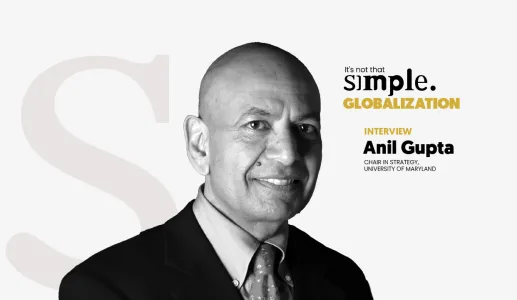
Anil Gupta
Michael D. Dingman Chair in Strategy & Entrepreneurship at Robert H. Smith School of Business, The University of Maryland.
He is the Michael D. Dingman Chair in Strategy, Globalization & Entrepreneurship at the Robert H. Smith School of Business, The University of Maryland at College Park. Anil is widely regarded as one of the world’s leading experts on strategy, globalization and entrepreneurship.
Ranked by «Thinkers50» as 'one of the world’s most influential living management thinkers', he has also been named by The Economist as one of the world's «superstars» for research on emerging economies, and inducted into the Academy of Management Journals’ «Hall of Fame».
He is one of only three professors, out of over 25000 worldwide, to have been elected a Lifetime Fellow of the three most prestigious academic bodies in his field – Academy of Management, Strategic Management Society, and Academy of International Business. He is the author of several best-selling books including «The Quest for Global Dominance», «Getting China and India Right», and «The Silk Road Rediscovered».
Anil Gupta received his doctorate from the Harvard Business School, an MBA from the Indian Institute of Management, and a B.Tech. from the Indian Institute of Technology.

Last update: january 2025
HeleneLandemore.png
Author
Hélène Landemore
Associate Professor of Political Science at Yale University. After graduating from the Ecole Normale Supérieure and Sciences-Po in Paris, she received her PhD in Political Science from Harvard University in 2008. She is the author of «Hume. Probabilité et Choix Raisonnable» (PUF: 2004) and «Democratic Reason: Politics, Collective Intelligence, and the Rule of the Many» (Princeton University Press, 2013, winner of the 2015 David and Elaine Spitz Prize for best work in democratic/liberal theory published two years earlier). She is co-editor, with Jon Elster, of «Collective Wisdom: Principles and Mechanism» (Cambridge University Press, 2012). She is currently researching and writing a new book provisionally entitled «After Representation: Rethinking Democracy for the 21st Century». She has published several articles based on subjects such as the consensus on deliberative democracy, the 2010-2013 constitutional process, crowdsourced policymaking in Finland and workplace democracy.

YannisPapadopoulos.png
Author
Yannis Papadopoulos
Professor of Political Science at the University of Lausanne in Switzerland. He has been a Visiting Professor and Fellow at many European academic institutions. His research focuses on the implications of governance transformations for democracy and accountability. His most recent books include «Democracy in Crisis? Politics, Governance and Policy» (Palgrave, 2013) and «Accountability and European Governance» (co-edited with Deirdre Curtin and Peter Mair; Routledge, 2012).

Last updated: October 2016
Chantal Mouffe.png
Author
Chantal Mouffe
Professor of Political Theory at the University of Westminster, she studied at the universities of Louvain, Paris and Essex. She has taught at various universities in Europe, North America and Latin America and has held research positions at Harvard, Cornell, the University of California, the Institute for Advanced Studies in Princeton and the National Centre for Scientific Research in Paris. Between 1989 and 1995, she was Directrice de Programme at the International Faculty of Philosophy in Paris. She is author of the books «Gramscian and Marxist Theory», «Dimensions of Radical Democracy», «Deconstruction and Pragmatism», «The Challenge of Carl Schmitt», «The Return of the Political» (1993) and «The Democratic Paradox» (2000), as well as co-author of «Hegemony and Socialist Strategy: Towards a Radical Democratic Politics» (1985) with Ernesto Laclau. Her most recent work is «On the Political» (Routledge, 2005).
VivienASchmidt.png
Author
Vivien A. Schmidt
Jean Monnet Professor of European Integration, Professor of International Relations and Political Science at Boston University and Founding Director of the Center for the Study of Europe at Boston University. Her research focuses on European political economy, institutions, democracy and political theory. Her most recent books include «Resilient Liberalism in Europe's Political Economy» (co-editor, 2013), «Debating Political Identity and Legitimacy in the European Union» (co-editor, 2011), «Democracy in Europe» (2006) – named by the European Parliament as one of the «100 Books on Europe to Remember» in 2015 – and The «Futures of European Capitalism» (2002). Recent honours, awards, scholarships and grants include an honorary doctorate from the Free University of Brussels (ULB), the Belgian Franqui Interuniversity Presidency for foreign academics, a research grant from the European Commission (DG ECFIN) and the HORIZON 2020 grant from the European Commission: (ENLIGHTEN: «European Legitimacy in Governing through Hard Times: The Role of European Networks» – as Lead Researcher at the Free University of Brussels).
WolfgangStreeck.png
Author
Wolfgang Streeck
Director of the Max Planck Institute for the Study of Societies in Cologne and Professor of Sociology at the University of Cologne. He is an Honorary Fellow of the Society for the Advancement of Socio-Economics and a member of the Berlin Brandenburg Academy of Sciences and the Academia Europaea.
The economic and financial crisis that began in 2008 continues to cause friction in the world. The seriousness of the situation is matched by the lack of widespread understanding of current events, as well as their origins. Wolfgang Streeck places the crisis in the context of the long neoliberal transformation of post-war capitalism that began in the 70s. Streeck analyses the subsequent tensions and conflicts involving states, governments, voters and capitalist interests, expressed in inflation, public debt and rising private debt.

Last updated: October 2016
RebeccaAbecassis.png
Author
Rebecca Abecassis
She has been Editor of International News and European News programmes at SIC Portugal since 2001. Between 1992 and 1997, she was primarily based in Paris and London, working for a range of organisations including Agence France Presse, le Nouvel Observateur, the BBC and CNN's European Center. From 1997 to 2000, she was a journalist at RTP Portugal. She is currently Editor of the European business programme The Europeans. She has interviewed various political leaders, writers, economists and others, including Manuel Valls, Martin Schulz, Federica Mogherini, Pierre Moscovici, Frans Timmermans, Valdis Dombrovskis, Laurent Juppé, Anne Hidalgo, Jacques Delors, Charif Majdalani, Jean d'Ormesson, Alain Fabius, Vaclav Klaus, Vaclav Havel, Carl Bilt, Manouchehr Mottaki, Bronislaw Geremek, Joschka Fisher, Margot Walstrom, Timothy Garton Ash, Niall Ferguson and Amin Malouf.

PiaMancini.png
Author
Pia Mancini
Using software to promote public debate and encourage voter engagement, she hopes to update modern democracy in Argentina and other countries. Her work focuses on how democracy must be updated for the digital age. A political scientist, she is Director of Net Democracy, a foundation which, she describes, offers «a space where citizens can come together to imagine, design and implement innovations in the political system that broaden the spectrum of democracy.»

She co-founded a political party in Buenos Aires, Argentina, called Net Democracy, or The Net Party, of which she is Executive Director. She also chairs the arteBA Youth Commission. She obtained a degree in Political Science from Torcuato di Tella University and a Master's Degree in Asian Studies in International Politics from Australia's Monash University. Her previous experience as Chief Advisor and Deputy Secretary of Political Affairs for the City of Buenos Aires has provided her with a wealth of knowledge for her current role and preparation for the «Pia Mancini speech».
StevenPinker.jpg
Author
Steven Pinker
A Canadian-born, naturalised American psychologist and linguist, he obtained his Bachelor's Degree in Experimental Psychology at McGill University before moving to Cambridge, Massachusetts in 1976, where he has spent most of his career. He received his doctorate from Harvard University in 1979 and was awarded a Post-Doctoral Fellowship at MIT. He then became Assistant Professor at Harvard before returning to MIT a year later. He left MIT in 2003 after accepting a teaching position at Harvard, where he remains a member of the Psychology Department with the title of Johnstone Family Professor. He was also Assistant Professor at Stanford University. Striving to clarify his theses and make them accessible to a general public, he has published books such as «The Language Instinct», «How the Mind Works», «The Blank Slate: The Modern Denial of Human Nature», «The Stuff of Thought: Language as a Window into Human Nature» and «The Better Angels of Our Nature: Why Violence Has Declined». One of this evolutionary psychologist's latest books is entitled «The Sense of Style: The Thinking Person's Guide to Writing in the 21st Century», in which he argues that, despite all the conflicts currently ongoing in today's world, there has never been a better time to be alive. Named «Humanist of the Year» and Honorary President of the Canadian Psychological Association, Foreign Policy magazine included him in its list of the 100 greatest intellectuals in the USA and Time in its list of the Most Influential People in the World Today. He is a regular contributor to various publications, such as The New York Times, The Guardian, Time and The Atlantic. His tenth book, «The Enlightenment Now: The Case for Reason, Science, Humanism and Progress», was released in 2018 and has been published in Portugal.
MichaelSandel.jpg
Author
Michael Sandel
American philosopher and essayist, he is Professor of Political Philosophy at Harvard University, where he began teaching in 1980. After completing his undergraduate studies, he attended Brandeis University in Waltham, Massachusetts, before attaining his doctorate at Balliol College, Oxford, under the guidance of philosopher Charles Taylor, who was a profound influence on him. In 1980, he accepted an invitation to join the Faculty of Arts and Sciences at Harvard University, where for decades he was in charge of the «Justice» course. With a total of over 15,000 students enrolled over the years, the course was one of the most widely-attended in Harvard’s history and was even recorded and put online for free access, obtaining millions of views. Included in «Foreign Policy's» list of 100 Global Thinkers, considered by Newsweek to be the «most relevant living philosopher» and an authentic «rock star», and by The New Republic as the «most famous philosophy professor on the planet», Michael Sandel postulates that philosophy should be taught through dialogue and only makes sense in close relation to everyday life, which is why he always tries to incorporate the context in which his discussions take place. His work has been translated into 27 languages and expressed in various books where moral reflection and the deepening of democratic life are irrevocably linked. His most recent bestseller, «What Money Can't Buy: The Moral Limits of Markets», is an invitation to readers to rethink the role that money and markets play in our lives and was named by Foreign Policy as one of the 20 must-read books of the year. He currently continues giving seminars on ethics and biotechnology and teaching the course «Ethics, Economics and the Law».